
Advisory

Why Compliance Is No Longer the End Goal

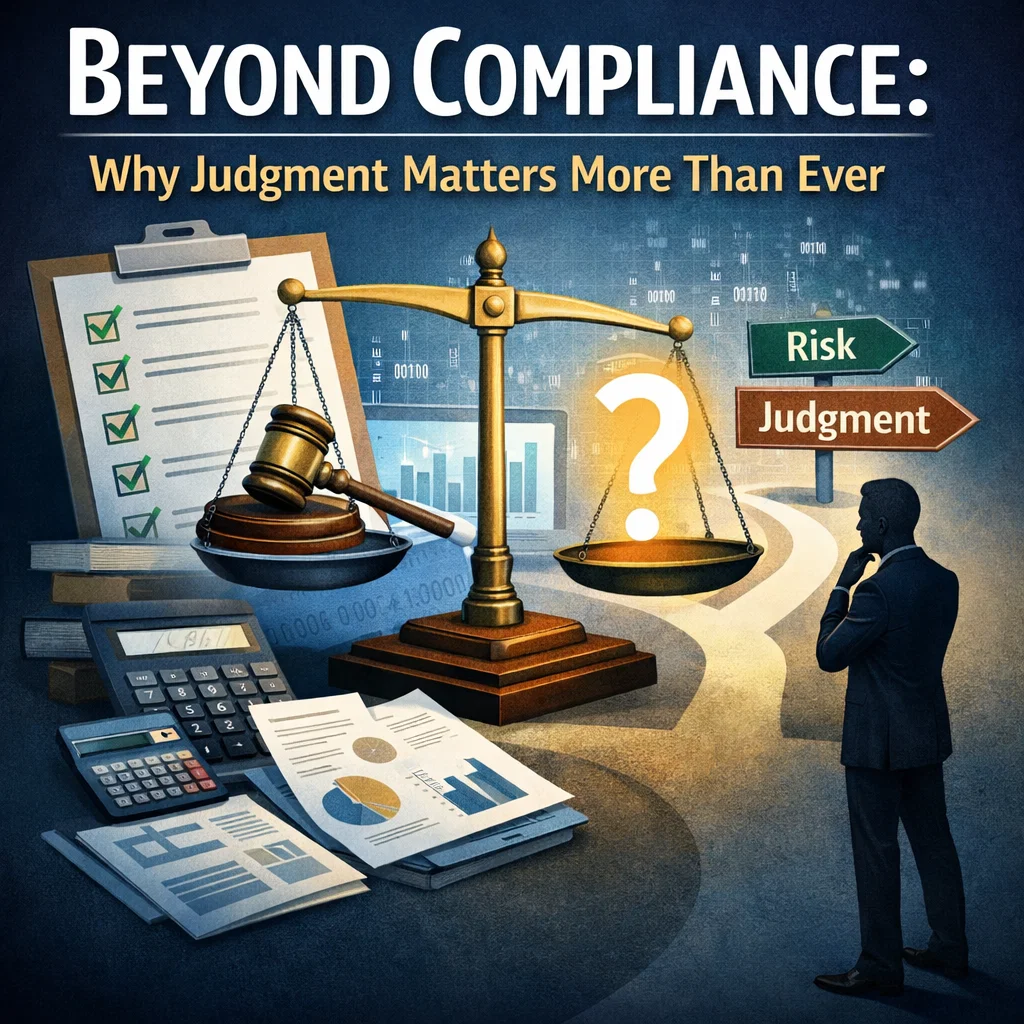
Compliance ensures rules are followed. Judgment ensures decisions hold up. Modern accounting, tax, and audit demand both.
December 31, 2025

Introduction

For decades, compliance has been treated as the finish line.

File the return.
Issue the report.
Meet the standard.

But in today’s environment — defined by regulatory scrutiny, automation, and complex stakeholder expectations — compliance alone is no longer sufficient.

What matters now is whether decisions are defensible, well-reasoned, and explainable under pressure.

This is where professional judgment becomes the real differentiator.

The Compliance Trap

Compliance answers a narrow question:

“Did we follow the rules?”

That question is necessary — but incomplete.

Organizations that optimize purely for compliance often encounter the same problems:

  • Controls that technically exist but don’t reduce risk
  • Tax positions that are correct on paper but weak in substance
  • Financial reporting that passes review but fails to inform decisions

In each case, the issue isn’t technical failure — it’s judgment failure.

Why Judgment Matters More Than Ever

Three forces have shifted the profession:

1. Automation Has Flattened Technical Advantage

Software can now:

  • Prepare returns
  • Reconcile accounts
  • Flag anomalies
  • Apply rules consistently

What it cannot do is evaluate nuance, intent, or downstream risk.

Judgment has become the scarce skill.

2. Regulators Look Beyond Form

Audits, examinations, and disputes increasingly focus on:

  • Rationale
  • Documentation
  • Decision processes
  • Internal consistency

The question is no longer what you did — but why you did it.

3. Decision-Makers Need Insight, Not Outputs

Executives don’t need another checklist.
They need clarity on:

  • Risk tradeoffs
  • Financial consequences
  • Strategic implications

Compliance produces outputs.
Judgment produces decision-useful insight.

What Judgment-Driven Work Looks Like in Practice

Judgment shows up differently across disciplines:

Accounting

  • Designing policies that reflect economic reality, not just minimum standards
  • Explaining financial results in a way leadership can actually use
  • Structuring processes that scale without sacrificing integrity

Tax

  • Taking positions that are technically correct and defensible
  • Understanding how facts, intent, and documentation intersect
  • Planning with an eye toward scrutiny, not just savings

Audit & Advisory

  • Identifying where controls matter most — not just where they exist
  • Framing findings in terms of risk, not citations
  • Helping organizations improve outcomes, not just pass reviews

Beyond Compliance: Defensibility

The real question professionals should be asking is:

“If this decision were challenged tomorrow, would it hold up?”

Defensibility requires:

  • Clear logic
  • Consistent application
  • Strong documentation
  • Professional skepticism

Compliance is binary.
Defensibility is durable.

Closing Thoughts

Compliance will always matter.
But it is no longer enough.

The organizations and professionals that stand out today are those who combine:

  • Technical accuracy
  • Sound judgment
  • Clear communication
  • Practical insight

That combination — not compliance alone — is what creates trust.

Need help applying this to your organization or situation?
If you’re navigating a complex accounting, tax, or audit issue and want clarity beyond the checklist, feel free to reach out.

Saad Siddiq, CPA
This article is provided for informational and educational purposes only and does not constitute accounting, tax, audit, or legal advice. Reading this article does not create a client relationship.