Chasing the lowest possible tax bill without understanding context often creates greater risk. True tax efficiency requires judgment, alignment with facts, and long-term perspective — not isolated tactics.
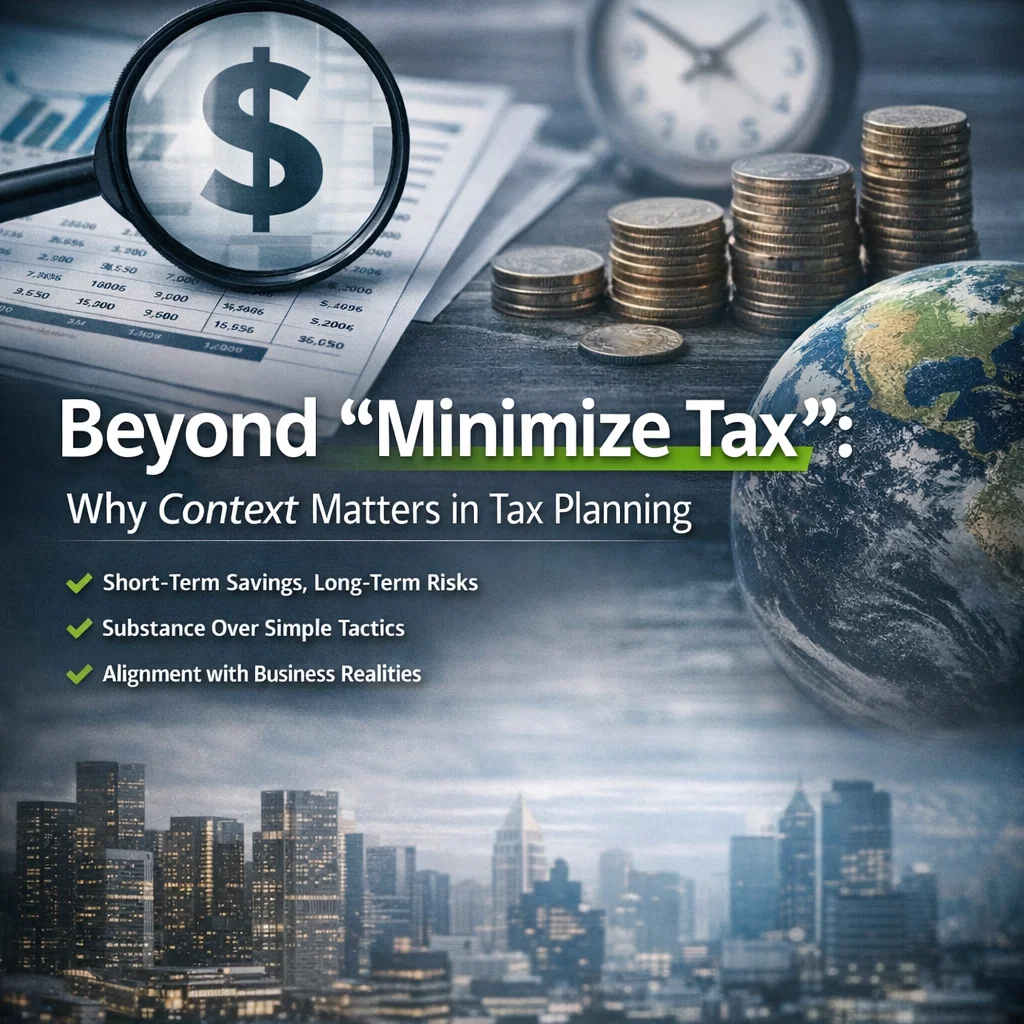
“Tax minimization” is one of the most common phrases clients use when discussing planning objectives. On its surface, it sounds reasonable — who wouldn’t want to pay less tax?
The problem is not the goal itself.
The problem is pursuing tax minimization in isolation, without understanding the broader financial, legal, and operational context.
When tax decisions are made without context, they often backfire.
A narrow focus on reducing current-year taxes can trigger unintended consequences, including:
In regulated or multi-jurisdictional environments, an aggressive tax move may solve a short-term problem while creating long-term structural issues.
Tax is rarely a standalone variable.
Many tax “strategies” fail because they prioritize form over substance.
Common examples include:
Tax authorities, auditors, and regulators consistently evaluate why something was done — not just whether a rule was followed.
When intent and reality diverge, risk increases.
Effective tax planning requires understanding:
A deduction that saves tax but restricts flexibility, increases scrutiny, or complicates reporting may not be a net benefit.
Judgment bridges these considerations. Checklists do not.
True tax optimization:
Tax avoidance tactics, by contrast, often:
That assumption is increasingly outdated.
A better question is not:
“How do I minimize tax?”
But rather:
“How do I structure my affairs so tax outcomes align with reality, strategy, and risk tolerance?”
When planning starts with context, tax efficiency follows naturally — and defensibly.
Tax planning without context is not planning — it is optimization in a vacuum. Sustainable outcomes come from understanding the full picture, exercising judgment, and recognizing that the lowest tax number is not always the best decision.
